Title: How Big is a Million?
Thursday, November 19, 2009
How Big is a Million?
Title: How Big is a Million?
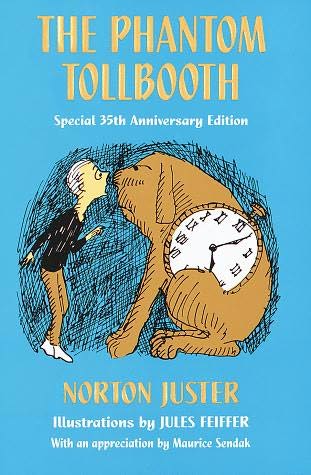
The Phantom Tollbooth
Author: Norton Juster
Illustrator: Jules Feiffer
Grade Level: 5-8
NCTM Content Standards: Geometry, numbers/operations, measurement
Summary: The Phantom Tollbooth tells the story of Milo, a lethargic young boy who chances to discover a magical tollbooth. Traveling through the booth, he finds himself in a fantasy world in the midst of a civil war between lovers of words (led by King Azaz) and lovers of numbers (led by the great Mathemagician). Accompanied by his watchdog friend Tock and the cranky Humbug, Milo journeys through the magical realms of sight, sound, and context in a quest to return the Princesses Rhyme and Reason to the land and restore peace once and for all. Facing “punny” demons, he discovers the power of knowledge and learns more about numbers and words than he ever thought important.
Uses: The Phantom Tollbooth relies heavily on speech in both the sections on words and the sections on numbers. When Milo first arrives in Digitopolis, the land of numbers, he encounters a talking Dodecahedron (who uses each of his faces to convey a different emotion) who points out the use of mathematical language in everyday speech, referencing phrases such as “high hopes” and “narrow escapes” and “wide world.” A possible activity that could employ both themes of the world in The Phantom Tollbooth could ask students to search for everyday clichés that involve mathematical vocabulary. This would connect mathematics to the world outside of school. It might also be fun for students to create characters out of geometric shapes, determining how many emotions each shape can convey, based on the number of faces it has, just like the Dodecahedron.
Another interesting episode involves Milo’s encounter with 0.58 boy. The boy explains that the average family has 2.58 children and that he is the 0.58 in his family. Milo objects that averages aren’t real, but in fact, are imaginary. The 0.58 boy argues that averages are very useful at times. Students can find such averages and statistics in the world and discuss what it would mean to be 0.58 of a person, and such.
Although not an activity, an important point of the story is that the Mathemagician’s magic wand is actually a pencil. This idea can be brought up repeatedly from time to time, having the students use their own pencils to perform magic. For example, they can make numbers disappear with the equation 4+5-9 which equals zero, an “invisible” number.
Wednesday, November 18, 2009
Math Curse
Recommended Grade Level: 3-5
NCTM Standards:
Number and Operations, Algebra, Measurement, & Data Analysis & Probability
Summary:
This highly amusing story is about a girl who has become the “victim of a math curse.” It all begins on Monday in math class when her teacher, Mrs. Fibonacci, says, “You know, you can think of almost everything as a math problem.” By Tuesday, EVERYTHING in the girl’s life has transformed into a mathematical problem. While getting ready in the morning, she finds herself wondering if she will make it to the bus on time. Then, while taking the milk out for her cereal she asks, “How many quarts in a gallon? How many pints in a quart?” Each page of the book is covered with these types of problems related to mathematics in everyday life. All of the problems involve number and operations, algebra, measurement, and data analysis and probability. At the end of the story, the heroine falls asleep and dreams that she is “trapped in a room with no doors and no windows and the room is covered with a lifetime of problems.” In order to finally break the math curse, the heroine uses fractions!
Suggestions for Using Book with Students:
We live in a mathematical world; it is important for students to understand connections between mathematical ideas and to recognize mathematics in contexts outside of the classroom. A teacher could read this book to students, perhaps a page at a time (as Aliyah suggested), to help them become aware of these connections. After reading the entire book, the teacher could tell students that he/she is putting a “math curse” on them and ask them to keep a journal for one day in which they record all of the mathematical problems/things that they notice in their everyday lives. To break the curse, the teacher should provide the class with a problem that they must work together to solve.
Reading this book to students would be a fun way to help students develop number sense and provide them with an opportunity to practice solving problems related to each of the content areas. After reading each page, I would have the class work together to solve the problems. I would encourage students to make use of different methods each day (e.g., mental calculations, estimation, paper-and-pencil, using manipulatives, or calculator). The answers to the problems are located on the back cover of the book.
After reading the page with the chart (a bar graph depicting the number of birthdays each month), the teacher could have the students work together to create their own class birthday chart. He/she could ask the students to identify which months have the most and the least number of birthdays.
A teacher could read the pages about fractions either before or after introducing students to fractions. Fractions seem to be a very difficult concept for many young students; this book would help to make fractions seem more tolerable! The teacher could then bring in some type of (non-allergenic) food that the class will have to figure out how to share amongst themselves (using fractions). (The teacher can hide extras behind his/her desk to make sure that everyone gets a whole piece at the end of the activity. Make sure that there is enough for everyone!)
The Greedy Triangle
written by Marilyn Burns and illustrated by Gordon Silveria
Recommended Grade Level: 1-3
NCTM standards: Geometry, Connections
Summary: This book tells the story of a triangle who is initially happy with the many situations in which he finds himself: he can be a piece of pie or the roof of a house, a sailboat sail or the face of a pyramid. Over time the triangle tires of his life and visits a shapeshifter who transforms him into a quadrilateral. Again he tires of his four-sided adventures and visits the shapeshifter again, and again, and again, each time being given one more side and one more angle and each time returning, bored with his new life. As he changes shape, he begins to neglect his friends and feel isolated and confused. He returns to the shapeshifter and asks to be turned back into a triangle, unsure why he was unhappy with this life in the first place.
Uses for this book: This book is a good introduction into basic geometrical shapes and it shows the difference between shapes when one side and one angle are added, changing the shape completely. One useful activity would be a shape stroll where students walk through the school looking for shapes in the real world. After this, students could create an art project where they construct familiar objects out of cut paper polygons.
Thursday, November 12, 2009
Flatland by Edwin A. Abbot, is a story told from the perspective of a character called the "square." Square describes to the reader his country called Flatland because it is the land of two dimensions. After explaining the social structure of his country, he travels to Lineland (the first dimension) and converses with the king of Lineland, but alas, Square is unable to convince the king of Flatland's existence. Similarly, once Square returns home, a sphere from Spaceland (the third dimension) tries to describe Spaceland. Square is unable to imagine it until the sphere pulls Square into Spaceland. Thus, the adventures of Square is a fun and interesting introduction to dimensions.
Recommended grade level: 7-8.
NCTM content standard: Geometry
Book uses: I would take ten to fifteen minutes a day to read a chapter of this book to the class and together discuss the concepts introduced. There's a plethora of material to discuss: social structures, angles, the relationships between 3-D shapes, 2-D shapes, lines, and points, and social commentaries of the subject of truth and heresy. Students could conceivably write story responses, draw the different lands, but mainly I think this book lends to great and fun mathematical discussions.
Cons: The book is written in an older english dialect. Also, it is heavily sexist in its treatment of females [shapes].
Sunday, November 8, 2009
NCTM Content Standard: Numbers and Operations and Probability
Summary: In this amusing picture book, readers follow the story of Little Sister as she eats all kinds of disgusting things and has no problem getting them down. But when Little Sister attempts to eat 10 peas, she throws up all over the place and creates a disgusting mess.
-Uses of this book:
K-1
- Counting - Ask the children if they notice a number pattern, or how the numbers change from page to page. Each time, the Little Sister eats one more disgusting thing than the page before until she reaches 10.
1-4
-Addition - Ask students to add up the total number of things that little sister eats
-Estimation - Have students estimate the total number of things that Little Sister eats, have students use a calculator to compute the total number.
4-6
-Probability - Students can play with probability and ratio by pretending all of the things that Little Sister ate were in one sack and figure out the probability of pulling out certain objects and the ratios of part to whole.